Aaahhh Marrakech - it makes one feel alive! An Arabic Africa, bustling with activity, dusty with the sand that blows in from the Sahara and in many ways seemingly unchanged for centuries - snake charmers, performing monkeys and Berber women offering henna tattoos. But behind the high walls of the Riads in the medina, exists another world altogether, tranquil serene and indulgent. It is a city of great contrasts - a frenetic life on the outside, in the souks, the busy streets and the main square, Jeema El Fna, versus the peace of the interior spaces with the intricate detail and hand craftsmanship - carved stucco, painted cedar and colourful Zelig tiles.
Tuesday, February 26, 2013
Monday, February 4, 2013
On the back of a Vespa - the best way to see Rome!
We have been back in Italy over the past few weeks - spending time in our house before our busy conferences begin again. The weather is superb with clear blue skies and crisp days. I have had my sister and my 16yr old twin niece & nephew staying, so went we to Rome for the day. Rome is only a 1.15hr trip from here, and our main intention of the day trip was to deliver on my Christmas gift to my niece & nephew - a 4 hour sight seeing trip around central Rome on the back of a Vespa - a la Audrey Hepburn "Roman Holiday" style. They didn't have to drive as that would be too much to deal with in the Roman traffic (let alone their lack of a driving license), but rather just had to sit on the back of a Vespa and take it all in - it doesn't get more Roman than that!
The end result? - a huge hit and I am left with trying to top that gift for Christmas 2013!
Tuesday, January 8, 2013
Ancient Ephesus, in modern day Turkey
On our cruise recently we stopped at the port of Kusadesi, Turkey, and visited the ancient city of Ephesus. It is a remarkable archeological city that totally surprised me with the extent of ruins preserved across the site. It covers an enormous land area, and indeed it is proported that the excavated ruins are only a small portion of what still lies beneath. What a place to be an archaeologist in this modern age!
Originally an ancient Greek city then later a major Roman city on the west coast of Asia minor near present day Izmir Province, it is an incredible place absolutely worth visiting (though it is my advice to avoid the serious heat of the summer period as even in early October it was very hot). In the Roman period of 1st Century BC, Ephesus is thought to have had a population of more than 250,000 which would have made it one of the largest cities, and therefore most important cities in the Mediterranean world. The sophistication of the architecture and the detail of building works is absolutely amazing and as a designer it always surprises me that this knowledge was lost during the dark ages in the centuries that followed. The city had building techniques that included "public malls" - rows of shops with intricate mosaic footpaths to entice visitors inside, toilet benches where high ranking people went to converse and discuss current affairs, and the term "doing your business" was a reality, and a library of monumental proportion that contained thousands of reading scrolls.
The city was famed for the temple of Artemis which was completed around 550BC and is today one of the seven wonders of the ancient world. Emperor Constantine rebuilt a large portion of the city and erected public baths. But it is hard to understand how such a commercial centre declined and was then forgotten, though it is thought that it was partially destroyed by an earthquake in 614AD and then silt slowly built up by the Cayster river made it no longer a port city on the Aegean sea, so its commercial viability was lost.
The great theatre, originally built in the Hellenistic Period in third century BC, and then enlarged by the Romans in 117AD, it still remains largely intact and over the past few years has still been used for major opera and musical concerts. I would love to be able to attend one of these, to sit in the seats where centuries ago concerts, plays religious and philosophical discussions took place.
One of the most impressive sites on this archeological ground is the library of Celsus. Completed in 135 AD by Celsus's son Galius Julius Aquila with his own personal wealth, the library honoured his father by housing over 12,000 library scrolls and served as a monumental tomb for Celsus. Celsus is buried in a sarcophagus beneath the library entrance which is a particular honour as very few citizens were buried within the city limits.
WebRep
currentVote
noRating
noWeight
Sunday, December 9, 2012
Villa d'Este Tivoli, Italy
Recently on a conference we took a group to visit UNESCO world heritage Villa d'Este in Tivoli, about 30km from central Rome. This magnificent villa and garden was commissioned by Cardinal Ippolito Il d'Este, grandson of Pope Alexander VI. Cardinal Ippolito was appointed Governor of Tivoli by Pope Julius III and given the existing villa as a gift. This official residence was not grand enough for him, so from 1550 until his death in 1572 he worked to reconstruct the villa plus build the most magnificent terraced gardens on the dramatic sloping land. The gardens of Villa d'Este are amoung the earliest of the 'giardini dell meraviglie' (gardens of wonder), and their design symbolise the flowering of the Renaissance culture plus had a profound influence on the development of garden design throughout Europe.
The great display of drama and magnificence in this garden is considered to be a result of Cardinal Ippolito's disappointment at his failed bids for papacy but further to this he wanted to impress and entertain his visitors. Many statues and much of the marble for the construction of the villa and its gardens was taken from nearby Hadrian's villa which had been left to ruins after the decline of the Roman empire. Reviving Roman techniques of hydraulic engineering plus using innovations in bringing sufficient water supply, the designers created hundreds of water fountains, nymphs, grottoes, plays of water and music that danced and performed across the site. The water fountains use hydrotechnical methods of pressure to re-channel the water from aqueducts - no power at all is used to pump water up the very steep slope which when you see the scale of this garden, that is a very impressive feat!
I loved visiting this delightful garden and combined with a visit to Hadrian's villa plus lunch at restaurant Sibilla (see earlier posts http://eclecticdiscoveries.blogspot.com.au/2012/12/restaurant-sibilla-tivoli-italy.html & http://eclecticdiscoveries.blogspot.com.au/2012/12/hadrians-villa-tivoli-villa-adriano.html) this is an extremely memorable day trip from Rome.
WebRep
currentVote
noRating
noWeight
Saturday, December 8, 2012
Restaurant Sibilla Tivoli Italy
Restaurant Sibilla in Tivoli on the banks of the Tiber river, approximately 30km from Central Rome is a spectacular place to enjoy a leisurely lunch or dinner. Operating as a restaurant continuously since 1720, this place is a tourist attraction itself, independent of the 2 fabulously interesting attractions, Hadrian's Villa and the beautiful Villa d"Este that exist nearby. It is quite amazing to consider that this restaurant has been in operation for over half a century longer than European settlement in Australia. On the day we visited, the sun was shining and we sat under the very impressive Wisteria vine that has existed for centuries. However in the winter months the fireplace and beautiful indoor furniture would also ensure dining indoors was equally comfortable.
We chose one of the fixed price menus which gave us large portions of incredibly tasty food. The service and attention to detail from all staff was excellent and it is easy to understand how this restaurant has been so successful, entertaining royalty and dignitaries for centuries. We were sharing the outdoor space with an Italian wedding which was wonderful entertainment and made us feel as if we were invited guests. The vistas are spectacular with a gorgeous garden area and Roman ruins right in the grounds where the tables are situated. All our guests thoroughly enjoyed this restaurant and we will definitely return on our next visit to Tivoli, in fact I would love to return when the wisteria vine is in flower as with its vast size the canopy of purple flowers would definitely be worth seeing.
WebRep
currentVote
noRating
noWeight
Friday, December 7, 2012
Hadrian's villa, Tivoli. (Villa Adriano)
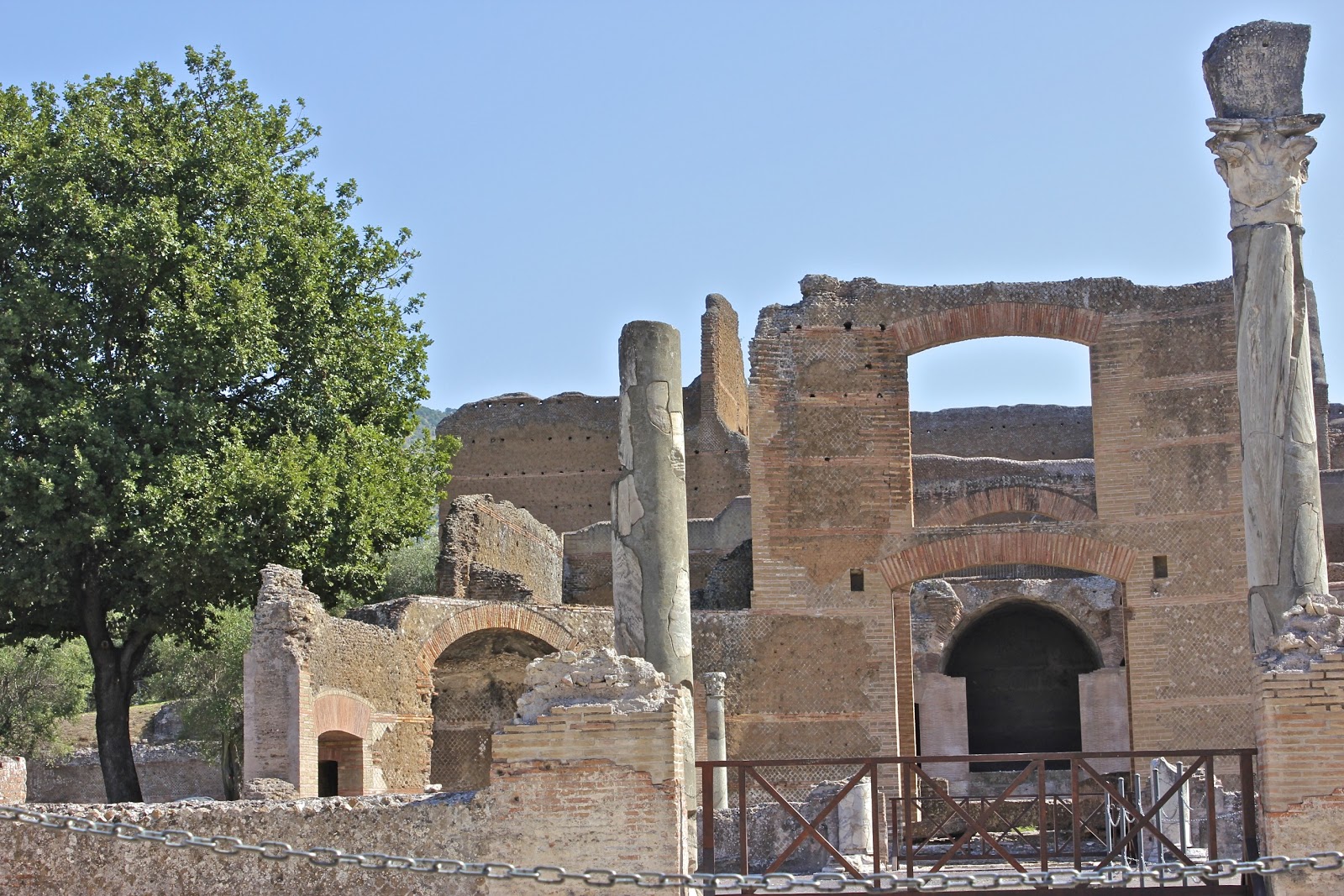
On a recent conference in Italy we visited Hadrian's villa at Tivoli, 29km outside central Rome. It was my first visit to this palace, built by Roman Emperor Hadrian during the second & third decades of the 2nd century AD. The palace is a incredible site of great archeological significance and a UNESCO World Heritage site. Situated in the hills above Rome as a summer retreat to avoid the heat, Hadrian actually ended up governing the empire from the villa in the later part of his life.
Set on over 250acres, the complex comprises over 30 buildings including palaces, temples, libraries, bath houses, and slave quarters. The buildings largely reflect the Greek, Roman & Egyptian architectural orders, borrowed from what Hadrian saw in his extensive travels and conquests. One of the most impressive areas is the pool and artificial grotto where large banquettes were held. The statues that surrounded the pool have been recreated from the ruins found in the grounds.
After Hadrian's rule, the villa was used by a number of his successors, but during the decline of the Roman Empire it fell into disuse and ruins. Once you see the size of the complex it is quite incredible to believe that this site sat as ruins for so long, especially when you consider how sophisticated the buildings and architecture were for their era. In 16th Century Cardinal Ippolito Il d'Este saw the potential of what the site held and removed most of the marble that decorated the facades of the buildings, plus the statues that surrounded the pool, to decorate his own villa nearby.
Be sure to visit the site model that gives you an appreciation of the extent of the complex for it is vast and impressive. Overall this place is hauntingly beautiful, very picturesque and with a guided tour allows you to wander around the archaeological remains and imagine the the life of this powerful dynasty almost 2000years ago.
WebRep
currentVote
noRating
noWeight
Tuesday, December 4, 2012
A Silverseas Cruise conference
We have been back in Australia for a few weeks after running more conferences abroad. One of the conferences we held was our first ever cruise conference. Having never been on a cruise previously, I have to admit, I was not necessarily rushing to go on one, but I was curious as to what life on board a large vessel would be like. Well, it was a truly fabulous week and both Lorenzo & I thoroughly enjoyed the experience - I admit we are now cruise converts, (what is not to love about it!) and we are looking forward to the program of future cruises conferences we have in place.
I am told we are a little spoilt because we began our cruising adventure on one of the best liners, Silverseas. Fitted with luxurious large suites, personal butlers for all cabins, beautiful food, a wonderful selection of wines & champagnes and a multitude of restaurant options, it really was a week of indulgence. We began in Istanbul which is one of my favourite cities - a true sense of east meets west is experienced across this sprawling metropolis. From here we visited Mykonos, Kusadasi, Rhodes, Santorini, Crete and finally Athens. Days were spent on shore at the various ports exploring, then the boat would normally leave around 9 or 10pm proceeding to the next port in time for a morning landing. Each day I loved waking around dawn, to throw open the curtains to view our new surroundings, a constant changing scenery. It was a lovely laconic way to travel, no rushing or stress, just the decision of whether to venture ashore in the morning or later in the day, and once back on board, the decision of which restaurant to dine in for the evening.
WebRep
currentVote
noRating
noWeight
Subscribe to:
Posts (Atom)